The Palband Blog
The Role of Reusable Covers and Liners in Circular Supply Chains
Circular supply chains are becoming a practical necessity rather than a long-term aspiration. Rising material costs, tightening environmental regulation and increasing customer scrutiny are pushing logistics operators to rethink how goods are protected, moved and returned. One of the most overlooked opportunities sits in an everyday operational detail: transit packaging.
Reusable covers and liners are playing an increasingly important role in reducing single-use waste, improving load security and supporting circular supply chain models. Rather than being consumed and discarded, these products are designed to stay in use, cycle after cycle, across distribution networks. When deployed correctly, reusable covers contribute directly to lower operating costs, improved sustainability reporting and more resilient logistics systems.
This article explores how reusable covers and liners support circular supply chains, where they deliver the most value, and why they are becoming standard equipment for forward-thinking operators.
Short Summary
Reusable covers and liners help logistics operations move away from single-use packaging by protecting goods across multiple transport cycles. This article explains how they support circular supply chains, reduce waste, improve load security and help businesses meet sustainability and compliance objectives without compromising operational efficiency.
Why You Can Trust Us
Palband works closely with logistics, retail and manufacturing businesses across the UK and Europe to reduce packaging waste and improve load protection. With decades of hands-on experience supplying reusable transit solutions, Palband understands how circular principles translate into real-world warehouse and transport operations. For tailored advice on reducing packaging waste and improving load protection, click here to speak to us today.
What Circular Supply Chains Really Mean in Practice
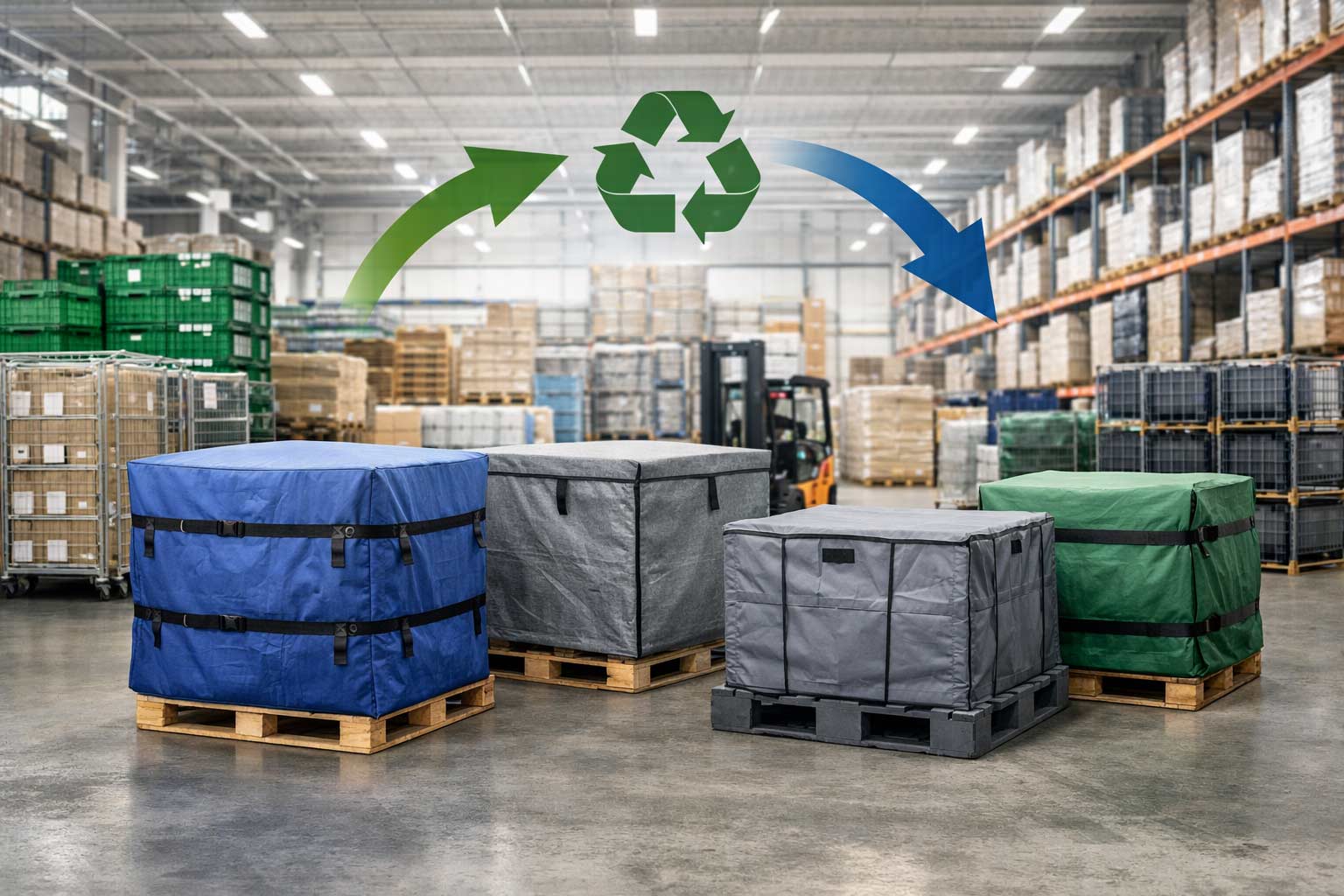
A circular supply chain is designed to minimise waste and keep materials in use for as long as possible. Instead of relying on disposable packaging that flows one way from supplier to landfill, circular systems prioritise reuse, repair and recovery.
In logistics environments, this means rethinking items that are traditionally treated as consumables. Stretch wrap, shrink film and disposable pallet covers are often used once and discarded, even though they represent a significant source of plastic waste. Reusable covers and liners challenge this model by offering long-life alternatives that can be integrated into closed-loop or semi-closed distribution networks.
The shift is not theoretical. Many large retailers and manufacturers are now under pressure to report on packaging waste, plastic usage and carbon impact. Reusable covers provide a measurable and visible improvement in these areas.
Packaging sits at the intersection of protection, efficiency and sustainability. While its primary role is to protect goods in transit, the type of packaging used can have a disproportionate environmental impact.
Single-use plastics are lightweight and cheap upfront, but they generate ongoing costs through waste handling, purchasing repetition and regulatory exposure. By contrast, reusable covers are designed to deliver protection across hundreds of journeys.
From a circular economy perspective, the goal is to maximise utilisation while minimising replacement. Reusable covers and liners achieve this by being durable, repairable and compatible with return logistics.
High-authority organisations such as Ellen MacArthur Foundation consistently highlight packaging reuse as one of the fastest ways to reduce material consumption within supply chains.
Reusable covers contribute to circular supply chains in several practical ways.
First, they reduce material throughput. A single reusable cover can replace dozens or even hundreds of single-use alternatives over its lifespan. This immediately reduces plastic consumption and waste generation.
Second, they extend asset life. By protecting palletised goods from impact, abrasion and contamination, reusable covers help reduce product damage and associated returns. Fewer damaged goods means fewer replacement shipments and less wasted inventory.
Third, they enable closed-loop systems. Many distribution networks already involve return journeys for pallets, roll cages or stillages. Adding reusable covers to these loops requires minimal operational change while delivering measurable sustainability gains.
For a deeper look at reusable transit protection options, Palband’s reusable pallet covers are designed specifically for repeated use in demanding logistics environments.
While covers protect goods externally, liners play an equally important role inside containers, cages and pallet boxes. Reusable liners prevent abrasion, dust ingress and moisture damage, especially for boxed or loose items.
In circular supply chains, liners are particularly valuable because they can be removed, cleaned and redeployed without compromising hygiene or protection standards. This makes them suitable for sectors such as food distribution, pharmaceuticals and automotive components.
Reusable liners also reduce the need for disposable inner packaging such as plastic bags or cardboard inserts. Over time, this significantly lowers material use and waste handling costs.
When combined with rigid or collapsible containers, liners support modular systems that can be adapted to different product types without introducing new single-use materials.
One of the common misconceptions around circular packaging is that it is more expensive. While reusable covers have a higher upfront cost than disposable film, their total cost of ownership is typically far lower.
Costs associated with single-use packaging include repeated purchasing, storage, waste disposal and labour time for application and removal. Reusable covers reduce or eliminate many of these recurring expenses.
In addition, damage reduction has a direct financial impact. Fewer damaged loads mean fewer customer complaints, fewer rejected deliveries and less rework in the warehouse. Over time, this improves customer relationships and operational reliability.
Reusable covers also offer predictability. Unlike consumables that fluctuate in price and availability, reusable assets provide stable long-term cost planning.
Regulatory pressure around packaging waste is increasing across the UK and EU. Extended Producer Responsibility schemes and plastic taxes are forcing businesses to account for the environmental impact of packaging choices.
Reusable covers and liners help organisations demonstrate proactive waste reduction and compliance. Because they are used repeatedly, they contribute positively to sustainability metrics and reporting frameworks.
Guidance from the UK Government on packaging waste reduction increasingly emphasises reuse over recycling, recognising that preventing waste in the first place delivers the greatest environmental benefit.
For businesses with ESG targets or sustainability reporting obligations, reusable covers provide tangible evidence of progress rather than aspirational commitments.
Introducing reusable covers into a supply chain requires some planning, but the barriers are often lower than expected.
Key considerations include selecting the correct size and specification, training staff on correct use, and establishing inspection and cleaning routines. In most cases, reusable covers integrate seamlessly into existing workflows.
Return logistics are often already in place for pallets or containers, making it straightforward to bring covers back into circulation. Even in open-loop systems, loss rates are typically low when covers are clearly identifiable and valued as assets.
Palband’s reusable pallet and stillage wraps are designed with durability and ease of handling in mind, supporting long-term use across multiple handling environments.
Supporting Resilience in Supply Chains
Circular supply chains are not only about sustainability. They also improve resilience. Reusable covers reduce reliance on external supply of consumables, which can be disrupted by price volatility or shortages.
During periods of supply chain disruption, businesses with reusable transit packaging are less exposed to delays caused by lack of materials. This operational independence can be a competitive advantage.
Reusable covers also standardise protection levels across shipments, reducing variability and improving predictability in transport outcomes.
Where Reusable Covers Deliver the Most Impact
Reusable covers are particularly effective in sectors with high shipment volumes and regular return flows. Retail distribution, manufacturing, automotive supply chains and food logistics all benefit from consistent load protection and reuse.
They are also valuable in environments where damage risk is high, such as multi-drop delivery routes or long-distance transport. By maintaining protection throughout the journey, reusable covers reduce the cumulative risk of handling damage.
In cold chain or temperature-sensitive operations, insulated variants can further enhance performance without introducing disposable materials.
Moving From Linear to Circular Thinking
Transitioning to a circular supply chain does not require a complete operational overhaul. In many cases, meaningful progress starts with small, targeted changes. Replacing single-use packaging with reusable covers and liners is one of the most accessible steps businesses can take.
These products deliver immediate environmental benefits while also supporting cost reduction, compliance and customer satisfaction. Over time, they help build systems that are less wasteful, more efficient and more resilient.
Circularity is not about doing more work. It is about doing the same work with fewer resources.
Next Steps for Your Operation
If your organisation is reviewing packaging waste, load protection or sustainability performance, reusable covers and liners are a logical place to start. Assess where single-use materials are still being consumed and consider where reuse could be introduced without disrupting operations.
Palband works with logistics teams to identify practical opportunities for reuse and specify solutions that fit real-world handling conditions.
To discuss how reusable covers could support your circular supply chain goals, contact the Palband team here: https://palband.com/contact